
What Happens to Students Who Are Anxious About Math and Coding?
July 21, 2026

One of the questions we hear most often from instructors is: "My students are already anxious about math. Many have never written code. If I ask them to learn R while learning stats, won't I just make them feel worse?"
It's a fair question. Our research also shows that many students enter introductory statistics courses worried about their ability to succeed. Some have had negative experiences with mathematics. Others are nervous about learning programming for the first time. Asking them to learn statistics and code can sound like doubling up on the challenge.
But here's the bottom line – they don't stay that way. Over a semester, they become less anxious, more confident, and actually capable at R.
Measuring More Than Performance
At CourseKata, we don't just measure what students learn; we also measure how they experience learning. Every semester we collect data on students' confidence, anxiety, perceived difficulty, and attitudes toward coding.
Why? Because if we only measure learning outcomes, we miss an important part of the story. Students who feel intimidated or disconnected from the material may engage differently with learning opportunities, and those experiences often vary across different groups of students.
By collecting these measures across multiple years, across high schools, community colleges, and four-year universities, we can ask an important question: What actually happens to students who begin the course worried about math and coding?
The Results Surprised Us
Across 45 diverse colleges and more than 7,400 students over three academic years (also documented in a few academic studies), we see remarkably consistent patterns: even though math anxious students began and ended less confident than their peers, all students reported similar shifts:
- Greater confidence using R
- More positive attitudes toward coding
- Lower programming anxiety
- Lower perceptions that programming is difficult
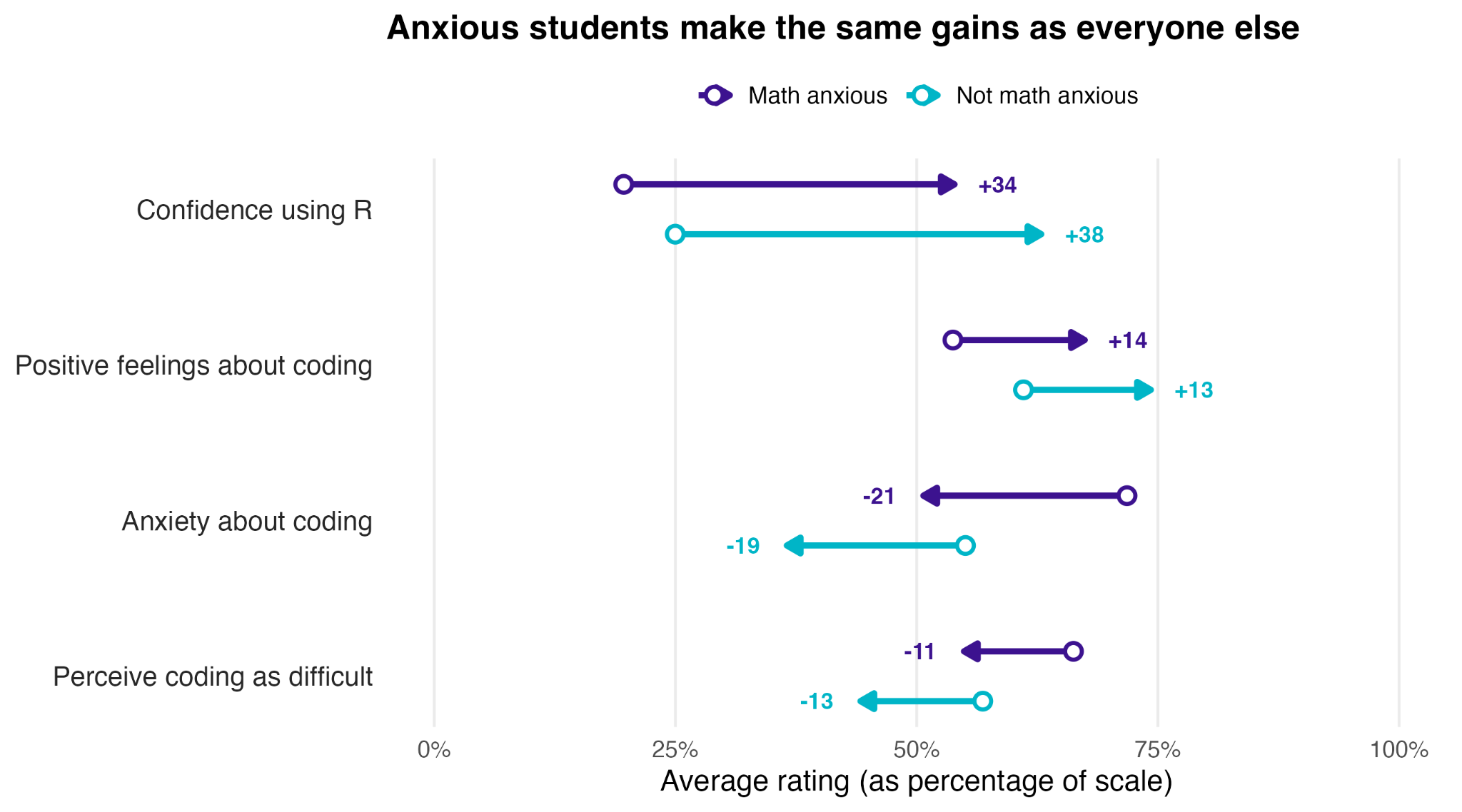
Perhaps most encouraging, these improvements are not limited to students who started the course feeling confident. Students who initially reported higher levels of anxiety about programming showed similar positive shifts over the semester. The same pattern appears among students from racially marginalized backgrounds and across different institution types.
Not Just Vibes, Actual Learning
Of course, lower anxiety and increasing confidence would not mean much if students weren't actually developing meaningful skills. Fortunately, that's not what we see.
On CourseKata's summative performance assessment—aligned with both our learning objectives and the GAISE recommendations—between 83% and 95% of students meet or exceed expectations on R programming tasks during data analysis. These assessments require students to write code and use statistical reasoning to navigate multivariate data sets, not simply memorize syntax or procedures.
Students aren't becoming more confident because we've lowered expectations. They're increasing their statistical programming skills and becoming more confident.
Using Data to Improve the Teaching of Data Science
One of the assumptions behind CourseKata is that students' confidence, anxiety, and attitudes aren't fixed characteristics. They're outcomes of the learning environment. That means we should measure them, improve them, and hold ourselves accountable for them with the same passion we have about learning.
This is the kind of research that motivates the teachers, researchers, and designers of the CourseKata community. We base our confidence not in the stuff we made, but in the experiences our students are having and what they actually learn.
References
Sutter, C. C., Jackson, M. C., & Son, J. Y. (2026). High School Students’ Perceptions of and Attitudes Toward R Programming in Statistics and Data Science. Journal of Statistics and Data Science Education, 1-16. https://doi.org/10.1080/26939169.2026.2635599
Sutter, C. C., Givvin, K. B., & Hulleman, C. S. (2024). Concerns and challenges in introductory statistics and correlates with motivation and interest. The Journal of Experimental Education, 92(4), 662-691.
Sutter, C. C., Givvin, K. B., Tucker, M. C., Givvin, K. A., Leandro-Ramos, A., & Solomon, P. L. (2023). Student concerns and perceived challenges in introductory statistics, how the frequency shifted during COVID-19, and how they differ by subgroups of students. Journal of Statistics and Data Science Education, 31(2), 188-200
Tucker, M. C., Shaw, S. T., Son, J. Y., & Stigler, J. W. (2023). Teaching statistics and data analysis with R. Journal of Statistics and Data Science Education, 31(1), 18-32. https://doi.org/10.1080/26939169.2022.2089410